Connect with us

News

Lib Dems oppose Reading Council budget over governance and financial concerns

Published

on

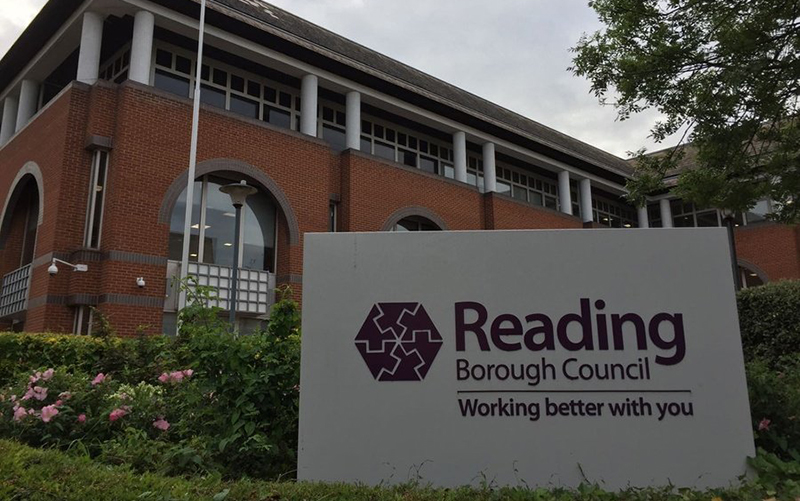
Reading’s Liberal Democrat councillors have voted against the Council’s 2026/27 budget, citing concerns over depleted reserves and last-minute financial planning that leaves future years unbalanced.

Speaking at last night’s Full Council meeting, the three Lib Dem councillors challenged the Labour administration over a budget that was only balanced two weeks earlier through an emergency £3.6 million draw from the Financial Resilience Reserve, leaving the Financial Resilience Reserve set to fall to just £269,000 by 2027/28.

Reserves running on empty

Councillor Anne Thompson highlighted the scale of the Council’s financial pressures: “To balance the budget, we will draw down £7.302 million from reserves — almost double the size of the drawdown a year ago. Our reserves are shrinking. The General Fund Revenue Reserve has fallen from £49.8 million to a forecast of £30.2 million in just one year, a 39% decline. You don’t have to be a mathematical genius to know that this can’t go on much longer.”

Advertisement

Cllr Thompson criticised the government’s funding settlement, noting that Reading receives nothing from the £865 million Recovery Grant despite having above-average deprivation in income, education, crime and barriers to housing. “Had the Recovery Grant been distributed through the fair funding formula as originally intended, Reading would have received an additional £2.05 million. That is a deliberate political choice by the Labour government in Westminster, and it is not fair.”

She added: “Our Adult Social Care caseload has grown by 311 people in nine months. Our looked after children numbers are rising when numbers are falling nationally. Yet we have three Labour MPs. Where were their voices for Reading when these decisions were being made?”

Last-minute budget raises concerns

Councillor James Moore focused on the administration’s handling of the budget: “This budget was not balanced in December. It had a £4.4 million gap as recently as ten weeks ago. It was only finally closed two weeks before this meeting by drawing an additional £3.6 million from reserves at the last minute. That is not long-term planning. That is firefighting.”

Cllr Moore pointed to a pattern of financial management problems: “Year after year of overspending — £9.3 million last year, £4 million forecast this year. Year after year of underdelivering on savings. The savings programme has delivered 73% of what was planned last year, and KPMG’s own forward look suggests only 66% will be delivered this year.”

Advertisement

He highlighted what he described as misplaced priorities: “We have requested a hearing loop system for Tilehurst Community Centre — a permanent accessibility improvement that would benefit the one in six people in the UK who suffer from hearing impairment. We’ve been told there are cost pressures that prevent it. Yet there were no cost pressures when it came to funding the Mayor’s £920 flight to watch football in Germany last year.”

Council Tax rises continue

The budget approved by the Labour-controlled council includes a 4.99% Council Tax increase — the maximum permissible without a referendum — for the third consecutive year. For a typical Band C household, the Reading element of Council Tax will rise by around £94 per year.

Cllr Thompson noted that public support for the increases is weakening: “The budget engagement showed 50.5% of respondents now oppose the Council Tax increase — a significant shift from last year when 60% supported it.”

Future years unbalanced

Advertisement

Despite the reserve draw, the Medium Term Financial Strategy shows budget gaps of £1.996 million in 2027/28 and £207,000 in 2028/29 still to be found.

All three Liberal Democrat councillors voted against the budget.

Events

DAY 1 – Reading Festival 2026: A Weekend of Big Performances, New Discoveries and Muddy Memories

Published

on

By

Charli xcx’s at Reading Festival - Photo Credit Henry Redcliffe

There is something about Reading Festival that you simply cannot replicate elsewhere. Every year, thousands of music fans descend on Richfield Avenue knowing that they are in for a weekend of huge performances, packed crowds, new discoveries and, almost certainly, some questionable weather. Reading 2026 was no different.

Across the weekend, the festival once again offered a huge variety of music, from rock and indie to rap, pop and electronic music. With major names including Charli XCX, Fontaines D.C., Dave, RAYE, Florence + The Machine and Chase & Status, there was plenty to keep the crowds moving from the opening acts through to the headline performances.

For us, one of the standout moments came from Charli XCX. Following the enormous cultural impact of her Brat era, it would have been easy to simply recreate that formula, but she chose to do something very different. Her performance was darker, more theatrical and heavily influenced by the sound and aesthetic of her latest work. A live band and army of dancers gave the set a completely different feel, while tracks such as 360, Von Dutch and Guess ensured that the Brat faithful still had plenty to scream along to.

There was also a reminder that Reading is a festival where you can stumble across something completely unexpected. Royal Blood surprised fans with a secret set at The Gallery, turning the tent into one of the liveliest places on site. Moments like this are part of what makes a festival special — you can plan your entire weekend around a timetable and still end up talking about something you never expected to see.

Advertisement

The weather, naturally, had its own plans. Rain arrived during the weekend and quickly transformed sections of the site into the familiar mixture of mud and wellies that British festival-goers know all too well. Rather than killing the atmosphere, it became part of the experience. Fans carried on dancing, artists played through the conditions and the festival carried on regardless.

Away from the biggest stages, there was plenty to discover. Geese, Declan McKenna, James Marriott, Skye Newman and Villanelle were among the artists providing some of the alternative sounds across the site, while the festival continued to give younger and emerging performers an opportunity to play to a much larger audience.

And that is ultimately what keeps Reading relevant. It isn’t simply about the headline acts. It’s about discovering an artist you hadn’t heard before, arriving at a stage because you have heard a great song from somewhere, bumping into friends in the crowd, getting completely soaked and still refusing to leave, or finding yourself watching a surprise performance that wasn’t even on your original plan.

Reading Festival 2026 delivered all of that. It was big, loud, unpredictable and occasionally very muddy — but above all, it was fun. And isn’t that exactly what a summer festival should be?

Advertisement
Continue Reading

News

Emergency Alert Sent to Phones Across South East as Heatwave and Wildfire Risk Escalates

Published

on

By


Residents urged to take extreme care with BBQs, cigarettes and anything that could start a fire

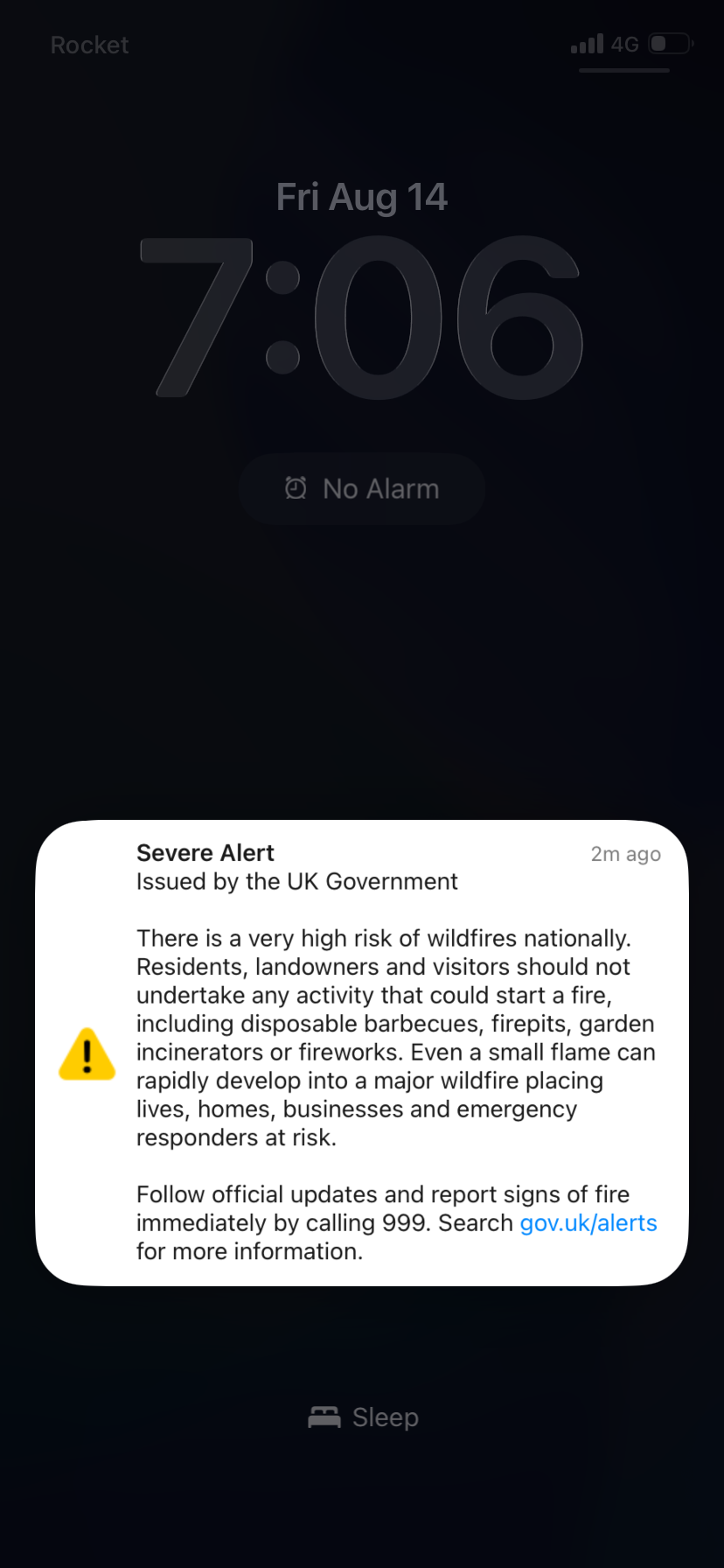
People across parts of South East England had their phones interrupted by an Emergency Alert this evening, warning of the serious risks created by the current heatwave and exceptionally dry conditions.

The alert was sent directly to compatible mobile phones, producing the distinctive loud siren-like sound and vibration used by the UK’s Emergency Alerts system.

This is not an ordinary weather notification. The national Emergency Alerts system is designed to warn people when there is a danger to life, with the message providing information about the emergency and what people should do to protect themselves and others. (Prepare⁠)

Advertisement

Why has the alert been issued?

The South East is experiencing exceptionally hot and dry conditions, creating a combination of extreme heat and heightened wildfire risk.

The UK Health Security Agency has an amber heat-health alert covering the South East, London and several other regions, currently extended until 10am on Saturday 15 August. (GOV.UK⁠)

The concern is not only about people becoming unwell in the heat. Dry grass, vegetation and woodland can ignite extremely easily, allowing fires to spread rapidly.

That is why residents are being urged to think carefully before using anything that creates a naked flame or produces hot embers.

Advertisement

BBQ warning: think twice before lighting one

One of the biggest concerns is the use of disposable BBQs.

A disposable BBQ may look harmless once the food has been cooked, but the charcoal and metal tray can remain extremely hot for a considerable amount of time.

In these conditions, a BBQ left on dry grass, thrown into vegetation or placed next to other combustible material could start a fire.

People should not use disposable BBQs in parks, woodland, heathland, fields or other areas where their use is prohibited or where there is a significant fire risk.

Advertisement

The Government has also introduced a temporary ban on the sale of disposable BBQs across the UK because of the wildfire danger. (Wales Online⁠)

Do not simply throw a BBQ in the bin

Another important message is about disposal.

Never put a hot or warm BBQ into a rubbish bin.

Hot charcoal can remain capable of igniting combustible material long after the visible flames have disappeared. A bin fire can quickly become a much larger incident, particularly during periods of extreme heat and dry weather.

Advertisement

Do not assume that a BBQ is safe just because it no longer has flames.

Allow it to become completely cold and follow local disposal guidance. If you are unsure, do not take the risk.

And never bury a hot disposable BBQ in sand or soil. Someone else could later step on the hot material and suffer serious burns, while buried embers can also remain a fire hazard.

Cigarettes and other sources of ignition

The warning extends beyond BBQs.

Advertisement

A cigarette end thrown onto dry grass can potentially start a fire. So can a campfire, fire pit, fireworks, glass or other objects that create or concentrate heat.

During these exceptionally dry conditions, people should avoid anything that could accidentally ignite vegetation.

If you see a fire starting in open land, move away from the area and report it to the emergency services when it is safe to do so. Do not put yourself at risk trying to tackle a rapidly spreading fire.

The heat itself can also be dangerous

The Emergency Alert comes as health authorities continue to warn about the effects of extreme temperatures.

Advertisement

People are being advised to:

  • Drink plenty of water and other fluids.
  • Stay out of direct sunlight during the hottest part of the day.
  • Keep homes as cool as possible.
  • Avoid strenuous exercise during the hottest hours.
  • Check on elderly or vulnerable relatives, friends and neighbours.
  • Never leave children or animals in parked vehicles.

Symptoms of heat exhaustion can include heavy sweating, dizziness, weakness, headache and nausea.

Confusion, loss of consciousness or a seizure can indicate heatstroke, which is a medical emergency.

Take tonight’s alert seriously

Receiving an Emergency Alert on a phone can be unsettling, particularly when it arrives unexpectedly in the evening.

But the purpose of the system is precisely to make sure people receive an urgent warning when authorities believe there is a significant threat to life.

Advertisement

The message should be read carefully and the instructions followed.

For people across the South East tonight, the wider message is straightforward:

Stay cool. Stay safe. Avoid unnecessary outdoor flames. Do not use BBQs where they are prohibited or unsafe. Never leave hot charcoal behind, and never put a hot BBQ into a bin.

With the ground exceptionally dry, what might normally be considered a small and manageable source of heat can become the starting point for a serious wildfire

Advertisement
Continue Reading

News

Reading Crime: Do the Latest Figures Tell the Full Story?

Published

on

By

pexels-cottonbro-7121056-1080px

Recent crime figures published by Thames Valley Police and Crime Commissioner (PCC) Matthew Barber highlight reductions in several key offences, including knife crime, vehicle theft and shoplifting. However, a closer look at the data reveals a more mixed picture, with anti-social behaviour and overall demand on the force both increasing.

The PCC’s Annual Report 2025/26 states that Thames Valley Police has made progress in tackling a number of priority crimes. But the same report also shows that reports of anti-social behaviour increased from 7,232 to 9,565 incidents over the past year – a rise of 32% across the Thames Valley.

The report also records a 7% increase in overall incidents, with Thames Valley Police responding to more than 500,000 incidents during the year. Demand on the force has also grown, with 999 emergency calls increasing by 4%.

Reading remains above the regional average

While the PCC’s report focuses on force-wide performance, publicly available crime data from Police.uk and the Office for National Statistics (ONS) indicates that Reading continues to record a higher crime rate than the Thames Valley average. Robbery offences have also shown an upward trend locally over the past three years.

Advertisement

Violence against the person also increased by 1% across Thames Valley, according to the annual report, while national figures showed a 1% decrease over the same period.

Independent inspectors identify areas for improvement

The latest HM Inspectorate of Constabulary and Fire & Rescue Services (HMICFRS) PEEL inspection, published this week, found that Thames Valley Police continues to perform well in several areas, including neighbourhood policing and crime prevention.

However, inspectors also identified weaknesses in crime investigations and safeguarding vulnerable people, concluding that further improvements are needed in these areas.

Responding to the inspection, PCC Matthew Barber acknowledged that improvements are still required and said financial pressures mean difficult decisions must be made about where resources are allocated.

Serious crime challenges remain

The PCC’s annual report also shows the force achieved a 10.6% charge rate for rape and sexual offences, meaning around one in ten recorded cases resulted in a charge during the reporting period.

Advertisement

Meanwhile, Government funding for victim support services fell by 4.2%, placing additional pressure on organisations supporting victims across the Thames Valley.

A mixed picture

Taken together, the latest figures suggest that while Thames Valley Police has achieved reductions in some headline crime categories, other indicators point to increasing demand and continuing challenges.

The rise in anti-social behaviour, higher incident volumes, findings from the independent HMICFRS inspection and Reading’s above-average crime rate indicate that public safety across the area remains a complex picture rather than one defined solely by falling crime statistics.

Sources: Thames Valley Police and Crime Commissioner Annual Report 2025/26, HMICFRS PEEL Inspection 2025/26, Police.uk crime data, and the Office for National Statistics (ONS).

Advertisement
Continue Reading

Trending

Copyright © 2026 Reading west.