Connect with us

News

Should RBC Incorporate Theale, Pangbourne, Calcot, Purley-on-Thames, and Tilehurst?

Published

on

reading-vs-westberks

The question of whether Reading Borough Council (RBC) should incorporate nearby areas such as Theale, Pangbourne, Calcot, Purley-on-Thames, and Tilehurst has been a topic of local discussionin the streets and local forum. While on the surface it might seem practical to expand Reading’s administrative boundaries, a closer look at infrastructure, education, and community services suggests that maintaining these areas within West Berkshire is the preferable option.

Population and Demographics

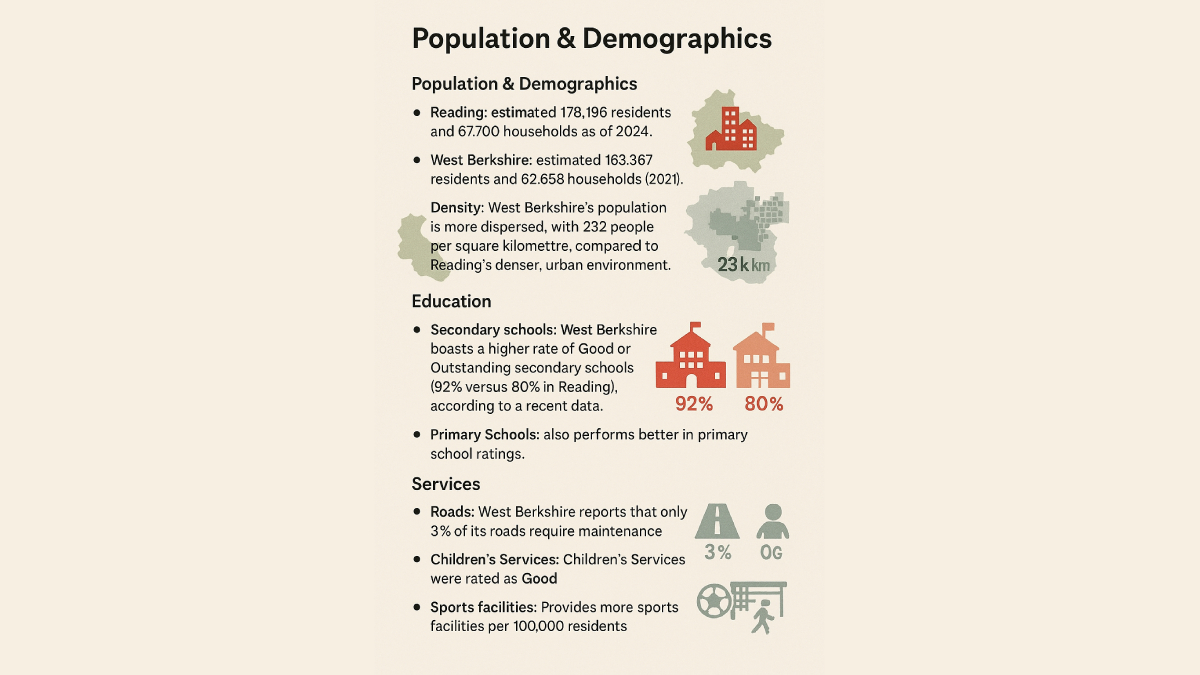
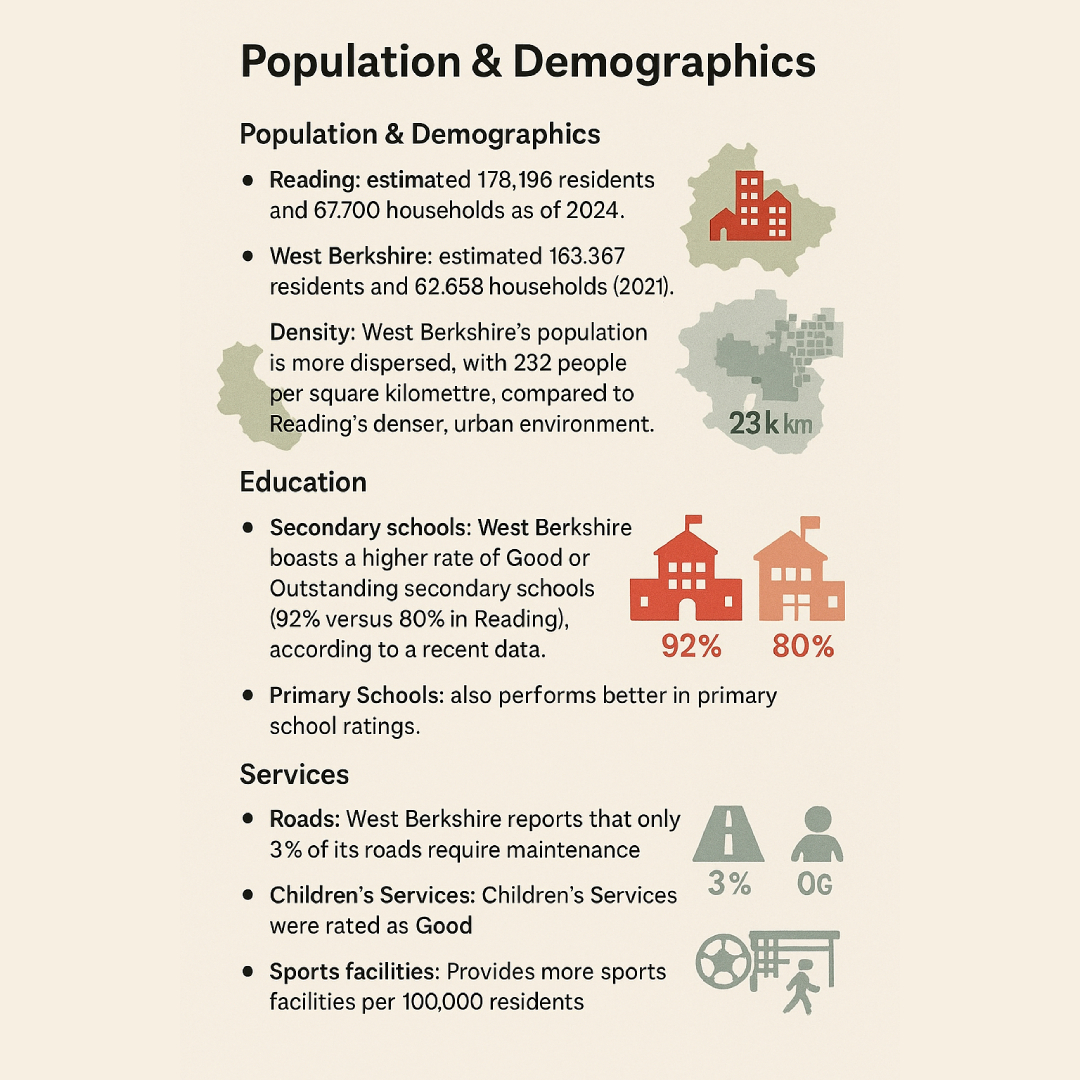
Reading currently has an estimated 178,196 residents across 67,700 households (2024), making it a dense, urban area. In comparison, West Berkshire has an estimated 163,367 residents in 66,658 households (2021 Census), with a population density of 232 people per square kilometer. Theale, Pangbourne, Calcot, Purley-on-Thames, and Tilehurst benefit from being part of this more dispersed and rural district, which allows for a better quality of life in terms of space, community, and accessibility.

Education

Education is another area where West Berkshire outperforms Reading. Secondary schools in West Berkshire have a higher rate of Good or Outstanding ratings at 92%, compared to 80% in Reading. Primary school ratings also favour West Berkshire, reflecting the district’s strong commitment to educational excellence. Incorporating these areas into Reading could risk administrative disruption in schools that are currently performing well.

Infrastructure and Services

West Berkshire also leads Reading in terms of infrastructure and public services:

  • Roads: Only 3% of West Berkshire’s roads require maintenance, lower than Reading’s proportion.
  • Children’s Services: West Berkshire’s services were rated as Good, while Reading’s received a “Requires Improvement” rating.
  • Sports Facilities: The district provides more sports facilities per 100,000 residents, supporting community health and recreation.
  • Recycling: West Berskshire collects glass recycling at the kerbside.

Residents of the areas under consideration already rely on Reading for shopping, entertainment, and rail travel to London. However, these practical links do not outweigh the advantages of remaining in West Berkshire’s jurisdiction.

Urban vs. Rural Characteristics

Reading is a dense, urban borough with a high concentration of its population. West Berkshire, on the other hand, is largely rural with dispersed communities, though it has population centres in Newbury and Thatcham and a large suburban area adjoining Reading. This rural character, combined with strong services, makes West Berkshire a better fit for these communities.

Conclusion

While RBC is a dynamic and growing borough, incorporating Theale, Pangbourne, Calcot, Purley-on-Thames, and Tilehurst is not recommended. West Berkshire currently provides superior infrastructure, higher educational standards, and a well-serviced rural environment. Keeping these areas within West Berkshire ensures residents continue to enjoy these advantages without unnecessary disruption.

News

Liberal Democrats Act on Residents’ Survey Findings

Published

on

By

pexels-pavel-danilyuk-7937329

Reading Liberal Democrats have written to Thames Valley Police after a residents’ survey identified the anti-social use of e-bikes and e-scooters — and their connection to drug dealing — as the single biggest concern facing local communities.

The survey, carried out earlier this year, received a significant number of responses from residents across Reading. E-bike and e-scooter-related anti-social behaviour topped the list of local concerns, with residents naming specific hotspots across the town.

Liberal Democrat Councillors have written to local Neighbourhood Policing Teams asking how the new Public Spaces Protection Order — introduced by Reading Borough Council and Thames Valley Police in March — is being deployed, and what residents should do to ensure their reports of incidents result in visible action.

The Councillors say they will also be pushing the council for a full breakdown of enforcement activity under the PSPO since it came into force, and to ensure that all Councillors have a proper opportunity to scrutinise its impact.

Cllr James Moore, Liberal Democrat councillor for Tilehurst ward, said: “Residents across Reading were clear. This is affecting their quality of life, and they want to see action. We welcome the PSPO, but we now need to know it is being enforced effectively — and we will keep pushing until we have answers.”

The survey also highlighted other significant priorities for residents across Reading, such as road and pavement repairs. Liberal Democrat councillors say they will be raising each of these issues in turn over the coming months.

Continue Reading

News

Reading Liberal Democrats call for answers over rushed City of Culture bid

Published

on

By

Reading Liberal Democrats are calling on the Labour-run Council to explain how much taxpayer money and officer time was spent on a City of Culture bid that collapsed within six days of submission — and why warning signs were ignored before it was submitted.

An investigation by The Reading Reporter has revealed that Reading’s expression of interest for UK City of Culture 2029 was rejected on 18 March, just six days after a planning meeting held in the Council Chamber. The report also reveals that the decision to submit the bid was made close to the deadline, meaning the bid-writing process was rushed. At the same time, competitor towns had spent considerably longer preparing.

Liberal Democrat councillors are questioning why the bid went ahead at all, given that participants at the planning meeting themselves identified significant risks — including “bid failure fatigue” among residents from previous failed bids, the risk of damaging Reading’s cultural sector if unsuccessful, and the likelihood that residents would view it as a waste of money. Those concerns proved well-founded.

The bid also involved the hiring of an external facilitation company, Golden Sankofa, to run the planning meetings — at an as-yet undisclosed cost to the public.

Most strikingly, the bid was pursued at the same time as the Council cut its culture budget from £3 million to just over £2 million — a budget that also has to cover parks, leisure centres and libraries. Reading Liberal Democrats are asking how the Council can justify the time and expense of a high-profile bid while simultaneously reducing the very investment that would have made Reading a more credible candidate.

James Moore, Reading Liberal Democrat Councillor for Tilehurst, said:

“Residents deserve to know how much of their money was spent on a bid that those involved knew was a risk — and that was apparently written in a rush. The warning signs were there before the bid was even submitted, yet the Council pressed ahead anyway.

“At the same time as pursuing this bid, Labour cut Reading’s culture budget. You cannot credibly pitch yourself as a City of Culture to a national panel while cutting the funding that supports culture in your own town.

“We’re not opposed to ambition for Reading. But ambition has to be backed by a plan, proper preparation, and a realistic assessment of whether the time and money involved are justified. This bid had none of those things.

“We are calling on the Council to publish a full account of the costs involved — including any external consultancy fees — and to explain what steps will be taken to ensure public money is not wasted in this way again.”

Reading Liberal Democrats are also noting that a 10-point recovery plan has been produced following the bid’s failure, but that no date has yet been set for the next meeting to take it forward — raising further doubts about whether the Council has a coherent strategy for culture in Reading

Continue Reading

News

Opening Date Confirmed for Reading’s New Central Library

Published

on

By

Reading new library

Reading Borough Council are delighted to announce the opening of the new Central Library at its new location in the Civic Centre, Bridge Street on Thursday 18 June.

The move is a significant new development for services in Reading’s central library, which will be housed in a new building, a light, fully accessible space, with a focus on learning, creativity and community use.

The new library will be fitted out with better facilities for studying, working and enjoying the town centre as well as an extensive range of fiction, non-fiction, local history and family history collections.

One of the major new features will be The Square, a versatile community and events area which will be used for activities, workshops and events of all kinds throughout the year. In addition, there are nearly 100 work and study spaces all equipped with free Wi-Fi and most of which have access to power points for laptops and devices.

The library has been designed keeping in mind all ages, such as:

Larger and more inviting children’s library featuring cosy reading areas and storytelling space.
A special teen area that offers graphic novels, appropriate reading material, comfortable seating and group study spaces.
Clear zones for working, meeting and quiet relaxation
A broad and diverse range of books for everybody to enjoy.
There are 18 (to borrow free) tablets and 8 laptops available.
10 public access computers
A special local history section about Reading’s history

The library will also be open for longer on Mondays, Tuesdays, Thursdays and Fridays, at 9am. Self-service hours will be offered the first hour of the day (9am-10am), where visitors can take their time to explore and enjoy the facilities.

The new library will be open to all residents and is warmly welcomed—even those who haven’t been to Central Library in a while.

King’s Road Library Update

From this week, services will no longer be available at the former King’s Road library site as around 60,000 books are moved to their new home at the Civic Centre.

Library books will not be due to Central Library and no fines will be paid during this transition.

Books on loan can still be returned to any of Reading’s six community libraries, or to the new Central Library when it opens on 18 June.

All 6 community libraries are open and have lending programs, access to computers and printers, and audiobooks. They are Battle, Caversham, Palmer Park, Southcote and Tilehurst and Whitley Libraries.

Continue Reading

Trending

Copyright © 2025 Reading west.